Do Food Dyes Affect Kids' Behavior? What the Research Actually Says
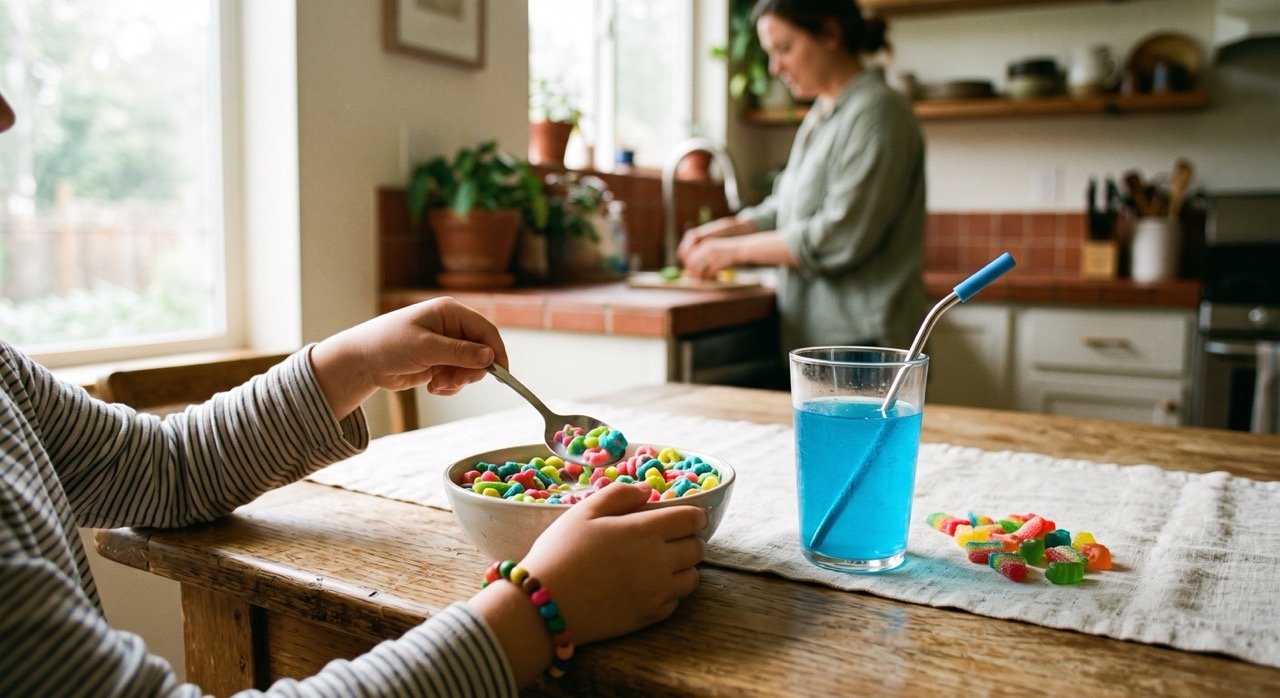
There is a birthday party at two o'clock, and by dinner you are living with a different child. Wired, weepy, up and out of the chair four times before anyone finishes eating. You find yourself doing the math on how much of that is sugar, how much is overstimulation, and how much is the electric-blue frosting.
Here is the direct answer: food dyes do affect kids' behavior in some children, and not in most. Averaged across a group, the effect is real but small, and inside that average sits a subgroup whose parents are not imagining what they see. Behavior is simply the marker that is easiest to notice. The same compounds turn up in research on the gut lining, the microbiome, immune and airway reactions, and DNA damage, and not one of them adds a single nutrient to the food. That is why our answer to families is the same whether or not a child is a behavioral responder: take the dyes out.
What the Behavior Research Actually Found
The disagreement is not whether an effect exists. It is how big it is and who it lands on.
The trial that changed the conversation
In 2007, researchers at the University of Southampton ran a randomized, double-blind, placebo-controlled trial in 297 children, ages three and eight to nine, drawn from the general population rather than selected for hyperactivity or food sensitivities. Children drank beverages containing mixes of six synthetic colors plus the preservative sodium benzoate, or a matched placebo. The team reported that artificial colors or sodium benzoate in the diet increased hyperactivity in both age groups. The strongest effect size was 0.20, a nudge rather than a transformation, and because the drinks mixed dyes with a preservative, the trial could not isolate which one did the work.
The 8 percent, and why the agencies split
A 2012 review pooled 24 published studies of synthetic food colors. Parent ratings showed an effect of 0.18, dropping to 0.12 after adjusting for publication bias, and the authors landed on the most honest number in this field: an estimated 8 percent of children with ADHD may have symptoms related to synthetic food colors. Small enough to explain the modest averages, large enough that in a classroom of 30 the sensitive child is probably there.
Three agencies read that evidence and landed in three places, which is the main reason parents feel dismissed.
The European Food Safety Authority called the Southampton findings limited evidence of a small effect. Europe required warning labels on those colors anyway.
An FDA advisory committee concluded in 2011 that causation in the general child population was not established, while allowing that these additives may be associated with adverse behaviors in certain susceptible children. It declined to recommend warning labels.
California's Office of Environmental Health Hazard Assessment reviewed seven approved dyes and concluded in 2021 that synthetic food dyes can cause hyperactivity and other neurobehavioral problems in some children, and that federal intake limits may not protect children's behavioral health.
The FDA's Acceptable Daily Intake levels for these dyes rest on studies that are 35 to 70 years old and were never designed to detect behavioral effects. Approved means an additive cleared a bar decades ago. It does not mean anyone tested it for the outcome you are worried about.
Behavior Is One Marker, Not the Whole Story
Hyperactivity gets the attention because it is visible across a dinner table. Look anywhere else and the picture does not get more reassuring.
The gut takes the first hit
Most synthetic colors are azo dyes, and they reach the colon largely intact, where gut bacteria cleave them into aromatic amines using enzymes called azoreductases. The microbiome is a participant in what these compounds become, not a bystander. Blue 1 produced persistent structural and functional changes in a gut microbiota model, and researchers reported in 2026 that tartrazine at intake levels considered safe altered gut bacterial composition in young rats.
That matters most in a child whose gut lining is already irritated. A leaky gut changes what crosses into circulation, which is part of why the same additives that bother a sensitive stomach can surface as mood. A child with cramping and urgency rarely reports cramping and urgency. A child with cramping and urgency melts down.
Immune and airway reactions
The FDA already treats one of these dyes as an allergen risk. Prescription drugs containing tartrazine carry a required label warning that it may cause allergic-type reactions, including bronchial asthma. Food carries no such warning, and the dose in a day of snacks is not smaller than the dose in a pill. Reported responses include hives, swelling, itching, and asthma flares, easy to blame on pollen or a new detergent.
What shows up when researchers look past behavior
Cancer signals in animals: Red 3 promoted thyroid tumors in male rats decades ago. The FDA finally revoked its authorization in food and ingested drugs in 2025, roughly 35 years after banning it in cosmetics.
DNA damage and colonic inflammation: Red 40 damaged DNA and produced low-grade colonic inflammation and dysbiosis in mice, and a 2024 study found gastrointestinal toxicity and DNA damage from erythrosine in rats.
Contaminants inside the dye itself: the Center for Science in the Public Interest's review of FDA testing found the most widely used dyes carry trace cancer-causing compounds such as benzidine, some of it in a bound form released in the colon and missed by routine purity testing.
Nothing on the other side of the ledger: synthetic dyes serve no purpose other than appearance. There is no nutrient, no preservation, no function to weigh against any of this.
Most of that work is in animals, and we say so plainly. It is still the body of evidence anyone has, and it points one direction.
Sensitivity to what you eat usually traces back to the state of the gut it lands in, and that is measurable.
Take our FREE assessment to measure the health of your Gut Microbiome
Take the Gut Health Assessment
Why We Ask Families to Remove Dyes Either Way
Parents often arrive here hoping for permission: if the two weeks are quiet, does the candy come back?
A quiet trial is not a clean bill of health
A behavior test measures one output over a few weeks. It cannot see what is happening to a gut lining, a microbial community, or a strand of DNA, and those changes accrue over years rather than announcing themselves at dinner. A child who shows no behavioral response is not unaffected. The effects are simply not visible in the one place you were watching.
If you want your own data, remove and reintroduce
The strongest evidence for testing at the family level comes from the INCA trial, which put 100 children with ADHD through a supervised restricted elimination diet. Thirty-two of 50 children on the diet improved significantly, and reintroducing foods triggered a behavioral relapse in responders. Scaled to a kitchen, that is two clean weeks, then one color family back for two or three days while you watch. Pick three specific behaviors beforehand — time to fall asleep, homework redirections, morning meltdowns — and have a teacher rate the same weeks blind. Vague impressions bend toward what you expect.
Where the dyes are hiding
Cake and candy are obvious. The items that quietly undo a removal are usually these:
Chewable vitamins and children's liquid medications: the most commonly missed source, and often a daily one.
Flavored yogurt, pudding cups, and applesauce pouches: foods parents file mentally as healthy.
Sports drinks, freezer pops, and drink mixes: high volume, high dye load, and the usual home of Blue 1.
Cereal, toaster pastries, boxed macaroni, and snack crackers: the everyday pantry rather than the treat shelf, and where Yellow 5 turns up most.
Pickles, marshmallows, and white icing: a few of the foods you would never guess contain dye.
A practical swap guide makes this far less miserable, since most replacements are colored with beet, purple carrot, or paprika. Worth knowing that not every natural colorant is gentle — annatto and carmine cause more reactions than their reputation suggests.
When symptoms keep shifting and removal only gets you partway, testing tends to find the pattern faster.
Curious how Functional Labs can improve Gut Health? Download this case study
Where to Start
Start with the highest-volume source in your house, usually a drink, and give it a week before changing anything else. Then handle the chewable vitamin and any daily medication, since those are easy wins and easy to overlook. Cereal and snacks come third. None of this requires a perfect pantry, and no one needs to be the parent who confiscates a cupcake at a party.
The labels are moving in your direction, slowly. California's School Food Safety Act removes six dyes from public school food by the end of 2027, and the FDA announced a plan in 2025 to phase petroleum-based dyes out of the food supply. That phase-out is voluntary and the timeline has already slipped, so it is worth moving ahead of it.
If your child does turn out to be a behavioral responder, you will see it within days of reintroduction, and you can hold that line without needing anyone to validate it. If nothing changes, take the dyes out anyway. You are removing compounds that were never food, and the space they leave gets filled by things that actually feed a growing body. And if symptoms run wider — stomachaches, loose stools, congestion, reactions spreading to new foods — the color is a passenger rather than the driver. That points to the condition of the gut underneath, which is solvable and a far better use of your attention.
If food reactions in your family keep outrunning your ability to explain them, you do not have to sort it out alone.
Interested in working with a Gut Specialist? Book with one of our team members to see how we can come alongside you.